
Wayfinding as Campus Strategy: Lessons from an Urban NYU Campus
Located primarily in Downtown Brooklyn, the campus sits within a dense business district where academic buildings blend seamlessly into the surrounding urban fabric. For visitors and new students, it was often difficult to distinguish NYU facilities from neighboring office and residential buildings. Without the clear edges of a traditional campus—no quads, gates, or sweeping lawns—the environment required a different strategy.
As part of a larger campus master planning effort, Via Collective was engaged to explore how wayfinding could help reestablish NYU’s presence and create a stronger sense of place. The As the Society for College and Urban Planning (SCUP) North Atlantic Regional Conference approaches this March, campus identity and user experience are taking center stage in planning conversations. In dense urban settings—where campuses blur into city blocks and first impressions are fleeting—clarity and legibility aren’t nice-to-haves. They’re essential. At Via Collective, these questions sit at the core of our work: how people arrive, orient themselves, and understand where they belong.
SCUP creates room for planners, designers, architects, and institutional leaders to reflect on how the built environment influences academic and campus life. For wayfinding designers, it is an opportunity to step back and look at navigation not as isolated signage decisions, but as an integral part of campus planning—one that influences accessibility, inclusion, and the everyday experience of students, faculty, staff, and visitors. Via Collective sees wayfinding and campus identity as integral to planning, especially in urban environments where the built environment can feel overwhelming at first glance.
Ultimately, whether through signs, maps, or subtle cues, our work is about helping campuses communicate themselves clearly, making every visitor’s experience intuitive, welcoming, and connected.
Reintroducing Campus Identity in Downtown Brooklyn
One project that significantly demonstrated our thinking around these ideas is our wayfinding work for New York University’s Polytechnic School of Engineering, now the NYU Tandon School of Engineering. When the engineering school officially returned to NYU in 2014 after a 40-year absence, it marked an important moment for the university—and introduced a complex challenge of identity and visibility.
goal wasn’t simply to improve navigation, but to make the campus feel cohesive, intentional, and unmistakably NYU.
Designing Through Research and Empathy
Our process began with listening. We conducted intercept interviews, tested multiple map concepts, and spoke with first-time visitors alongside long-tenured faculty and staff. These conversations revealed where confusion occurred, where anxiety surfaced, and where moments of clarity could be strengthened—particularly at key arrival points and decision-making nodes.
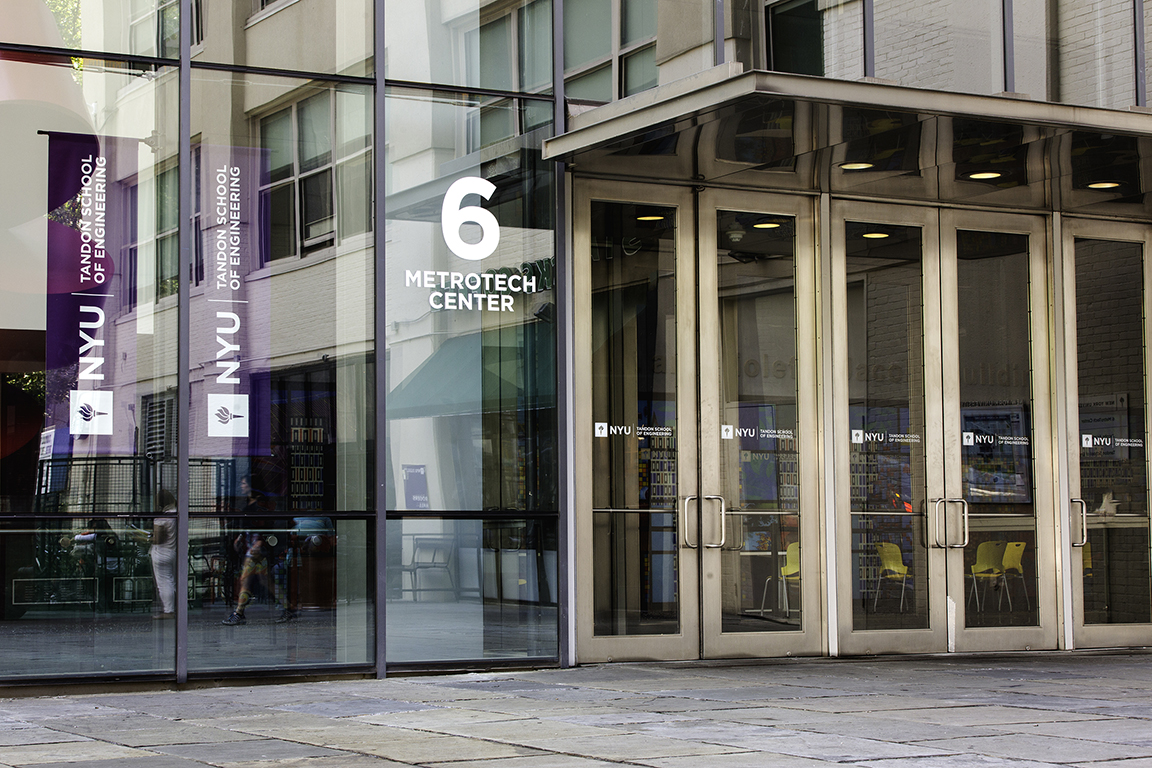
This research informed a comprehensive wayfinding strategy that addressed both exterior and interior environments. Identity signage, flags, directional signs, door identification, and interior landmarks were updated to reflect NYU’s branding while responding thoughtfully to the realities of a downtown campus.
Creating Familiarity Across Campuses
One of the most impactful outcomes was the development of a Brooklyn campus map inspired by NYU’s Washington Square campus. By borrowing familiar visual language and organizational logic, the map reinforced a sense of continuity across campuses—helping Downtown Brooklyn feel like an integral part of the larger NYU experience.
Paired with new exterior signage and environmental graphics, these elements transformed a collection of buildings into a recognizable campus presence. The result was an environment that felt more intuitive, welcoming, and connected.
Building Consistency for the Future
Beyond individual signs, Via Collective updated and refined the university’s signage standards manual to support long-term consistency. The revised guidelines make it easier for faculty and staff to order signage while maintaining alignment with branding and wayfinding principles—regardless of school, department, or fabricator – even when the school wasrenamed the NYU Tandon School of Engineering in 2015.
Continuing the Conversation at SCUP
Projects like NYU Tandon highlight the role wayfinding plays in campus planning—particularly in urban contexts where clarity, accessibility, and identity must work together seamlessly. These are exactly the conversations we’re looking forward to continuing at the SCUP North Atlantic 2026 Regional Conference.
Via Collective’s Studio Director, Jesse Kidwell will be attending the conference in Hartford, CT, from March 8-10, to connect with peers around campus planning, user-centered design, and strategies for creating legible, welcoming environments. If you’ll be at SCUP, connect with Jesse to continue the discussion.
Because good campus design doesn’t just move people from point A to point B—it helps them feel confident, included, and connected to place.