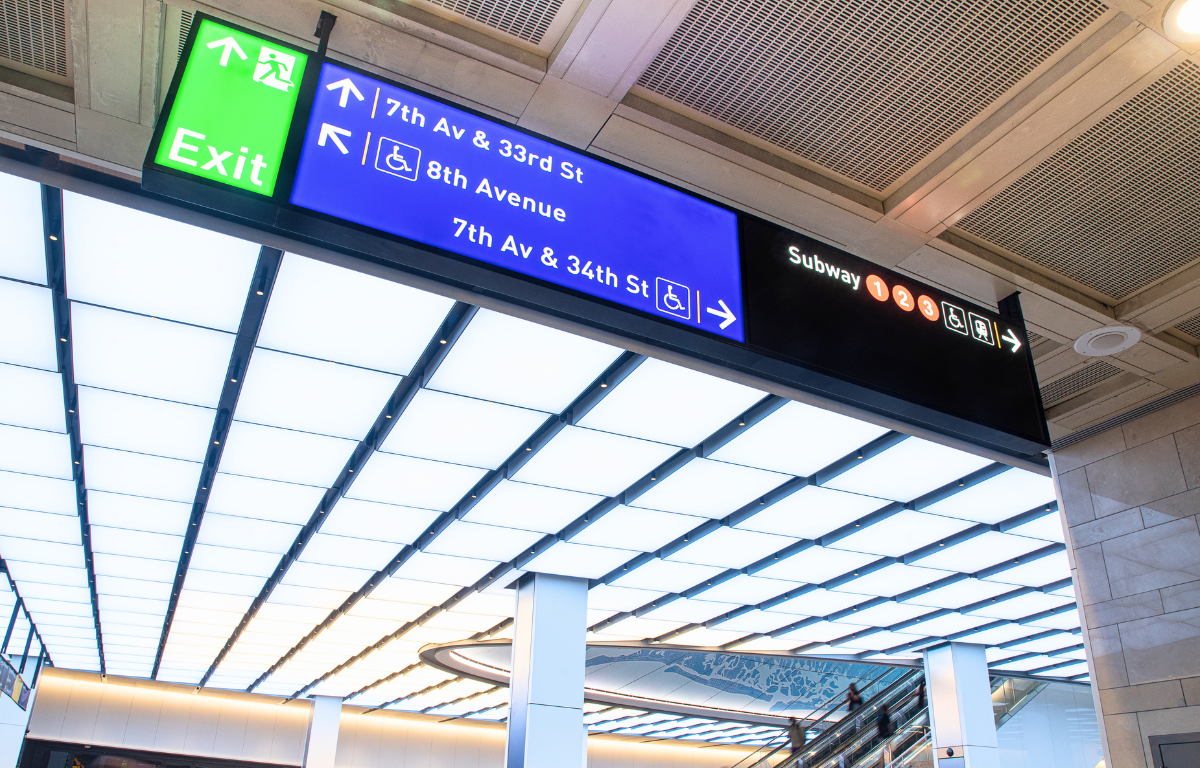
Whether you’re catching a flight, navigating a busy train station, or exploring a new city this summer, chances are you’re relying on the wayfinding cues within your environment to get around. The elements you encounter along your way take many forms, from tactile identification signage at the entrances to restrooms all the way down to an intuitive decision a visitor might make to walk up the accessible ramp leading directly to a building’s entrance. However, it’s important to remember that these components we’ve come to expect within our environment are the result of decades of grassroots activism and advocacy.
Even with these advancements, there is no such thing as a universal experience. As July marks the anniversary of the Americans with Disabilities Act (ADA), it’s an opportunity to recognize the profound impact the legislation has had on how we approach designing for the built environment, and how far we still have to go. More than a legal requirement, the ADA has fundamentally changed how designers, architects, planners, and engineers think about accessibility. The result is clear: buildings are now much more inclusive, intuitive, and usable for everyone.
At Via Collective, accessibility cannot be viewed as a checklist at the end of a project. We believe that communication begins by understanding the people who will use the space and all their different needs. This means that from the outset, we are considering how individuals with varying degrees of mobility, vision, hearing, language proficiency, cognitive abilities, ages, and levels of familiarity interact with their environment and what they might need to confidently navigate space. Features like tactile lettering and Braille, high-contrast colors, accessible routes, readable typography, visual and audible cues, and consistent sign placement ensure that people with different abilities can access the same environments and experiences. When those perspectives are considered from the outset, the result is a design that supports independence, reduces uncertainty, and creates a better experience for everyone.
This philosophy is especially important in areas of high stress, like transportation environments. Here, you can expect people who are under stress, managing luggage, traveling on tight schedules, or navigating through unfamiliar surroundings. At both the JFK Ground Transportation Center and the LaGuardia Airport Ground Access program, we developed intuitive wayfinding strategies that prioritize accessibility at key decision points, helping travelers transition between terminals, parking facilities, transit services, and ground transportation. The goal was not simply to direct movement, but to create a seamless journey for passengers of all abilities.
The same user-centered approach shaped our work on Grand Central Madison. Rather than treating tactile signage as a separate requirement, we integrated accessibility into a comprehensive interior signage system that included informational, directional, electronic, and tactile sign types. By communicating critical information consistently through multiple formats, the system we designed supports the wide variety of passengers moving through one of NYC’s newest transit connections every day.
Designing for inclusion also means recognizing that accessibility extends beyond physical mobility. At Penn Station, one of the busiest transportation hubs in the world, we developed a wayfinding strategy to support first-time visitors, infrequent riders, travelers with limited English proficiency, and passengers who rely on non-digital information. By reducing complexity and providing clear, intuitive navigation, the system helps minimize confusion and creates a more welcoming experience for millions of travelers each year.
At Babylon Station, we developed signage that complements station-wide ADA upgrades, ensuring the new accessible routes and features are communicated as clearly as they are constructed. Likewise, our work for the NYC Department of Citywide Administrative Services established interior wayfinding recommendations for 52 city-owned buildings, creating a more consistent and universal experience across courthouses, administrative offices, and other public facilities.
These projects reflect an important truth: well-designed wayfinding is about much more than compliance. It is a public service.
Thoughtful signage anticipates the questions people will have before they need to ask them. It provides reassurance during moments of uncertainty, communicates information clearly under pressure, and helps people move independently through unfamiliar environments regardless of individual ability. This philosophy, often called Universal Design, is the idea that environments designed to accommodate a broad range of users ultimately benefit us all. Accessibility features rarely serve just one audience. Clear typography improves legibility. Consistent placement makes navigation predictable. High-contrast graphics are just as valuable in bright sunlight as they are for people with low vision. The best wayfinding systems don’t call attention to themselves; they quietly remove barriers before they become obstacles.
As you travel this summer, take a moment to notice the details that make your journey easier. Notice the signs that point you in the right direction, the accessible routes that provide equitable access, the thoughtfully designed information displays, and the subtle decisions that help thousands of people move through the world. At Via Collective, we believe that the anniversary of the ADA is more than a milestone worth celebrating. It is a reminder that our work is an ongoing responsibility–one rooted in empathy, inclusivity, and a commitment to creating spaces where everyone has the ability to participate, explore, and belong. Inclusive wayfinding is not just about meeting standards; it is about designing places that truly serve the people who use them.