
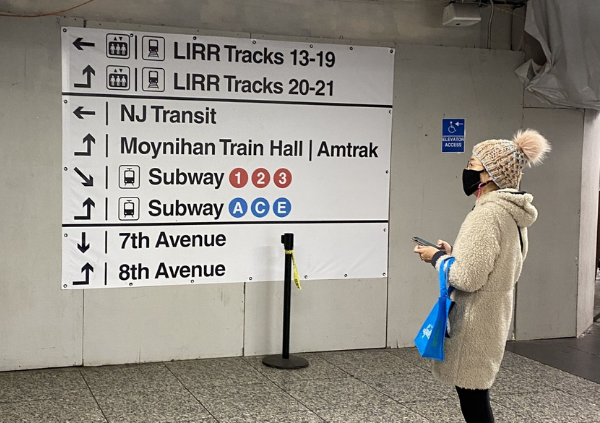
May is Mental Health Awareness Month, a time dedicated to increasing understanding around the many factors that influence emotional well-being. While conversations about mental health often center on healthcare, relationships, or workplace pressures, the built environment also plays a powerful role in shaping how people feel as they move through daily life. The experience of navigating a space, whether calming and intuitive or confusing and overwhelming, can directly affect stress, confidence, and overall comfort. In this way, design influences have the ability not only to support how people move through environments, but also how they emotionally experience them.
We’ve all experienced that moment when a long corridor ends at a T-junction and the only thing waiting there is a blank wall where a sign should be; the frustration, confusion, or panic sets in. Getting lost is often dismissed as a minor inconvenience, but in unfamiliar environments, it can quickly become overwhelming. From missing a turn to navigating a crowded transit station, getting lost creates stress that can be avoided. As part of our design process, it’s important to consider that these negative feelings can be particularly heightened for people already dealing with anxiety, sensory overload, or cognitive fatigue.
This is where thoughtful design matters. At Via Collective, we approach wayfinding as both producing functional solutions and a human-centered discipline. Signage, landmarks, environmental cues, and spatial organization all work together to help people understand where they are and how to reach their destination. But beyond navigation alone, effective wayfinding creates reassurance. It reduces uncertainty, simplifies decision-making, and helps people feel more in control of their surroundings.
This relationship becomes especially important in large public environments where people are often processing significant amounts of information under pressure. Anxiety can affect attention, memory, and spatial awareness, making unfamiliar places even more difficult to navigate. Poorly organized environments or inconsistent signage systems increase what psychologists refer to as “decision fatigue”, where every unclear intersection or missing directional cue adds cognitive strain.
By contrast, intuitive wayfinding systems help build someone’s mental map of the space and simplify movement through progressive disclosure, clear information hierarchies, universal icon standards, and consistent messaging. We believe that successful wayfinding is rooted in empathy. Effective systems prioritize simplicity, clarity, predictability and consistency that make navigation easier for a broad range of users. Well-placed signage can provide reassurance at key decision points before confusion has a chance to set in. As people become more oriented, stress levels naturally begin to decrease. At Via Collective, that principle guides the way we think about the user journey across every project.
Environmental design also contributes to navigation. Lighting, color, material changes, and architectural form can subtly guide movement through a space without relying entirely on signs. A naturally lit corridor may intuitively signal a primary route, while color-coded zones can help users distinguish between departments or destinations. These elements become especially valuable in complex environments like healthcare facilities, where reducing stress and creating a sense of calm can directly shape a visitor’s experience.
Healthcare environments provide one of the clearest examples of why this work matters. Visitors are often navigating emotionally charged situations while moving through unfamiliar layouts under pressure.. Airports, transit hubs, museums, and civic spaces present similar challenges, requiring large volumes of people to move confidently through complex environments. In each of these settings, effective wayfinding supports not only circulation but emotional well-being.
Airports in particular have increasingly recognized the connection between navigation, stress, and emotional comfort, leading many to introduce programs specifically designed to ease passenger anxiety. At Los Angeles World Airports’ Pets Unstressing Passengers (PUP) Program, therapy dogs are brought into terminals to provide comfort and emotional support for travelers navigating the stress of air travel. Similarly, Portland International Airport’s Animal Therapy Program uses volunteer therapy animals to create moments of calm and reassurance throughout the passenger journey. These programs acknowledge an important reality: navigating complex public environments can be emotionally taxing, and thoughtful design can help ease that burden.
As designers place greater emphasis on wellness, accessibility, and inclusivity, wayfinding is becoming an increasingly important part of human-centered design. While future systems may incorporate digital navigation tools, adaptive signage, or personalized mobile guidance, the underlying goal remains the same: helping people feel comfortable, informed, and in control of their surroundings.
At Via Collective, we see wayfinding as an opportunity to create environments that support dignity, confidence, and peace of mind. In a world where public spaces continue to grow more complex, thoughtful navigation systems can reduce stress rather than contribute to it, creating experiences that feel not only functional but genuinely supportive of the people moving through them.