
Airports are the gateways of modern travel. They remain the essential bridge between departure and arrival, but are only one component of the full travel experience. For anyone traveling to New York City, that journey begins with a deceptively simple question: Which airport should I fly into?
John F. Kennedy International (JFK), Newark Liberty International (EWR), and LaGuardia (LGA) each offer multiple modes of transit into the city. And while they may all ultimately bring you to New York, anyone who travels here regularly will tell you that the choice matters.
That choice is more than a logistical one. From the moment a traveler books a flight, they are beginning to build a mental map of their journey—one that will continue to evolve as they move through terminals, transit systems, and the city itself.
Cognitive Chaos
Before exploring what makes New York’s airport experience unique, it’s worth considering what travelers are already carrying with them when they arrive.
Is my flight on time? Did I pack everything I need? How long will security take? What happens if my connection is delayed?
Airports add another layer of decisions to an already crowded mental landscape. High sensory inputs such as bright lights, large crowds, overhead announcements, long TSA lines, or decisions about where to eat can quickly add to that cognitive load.
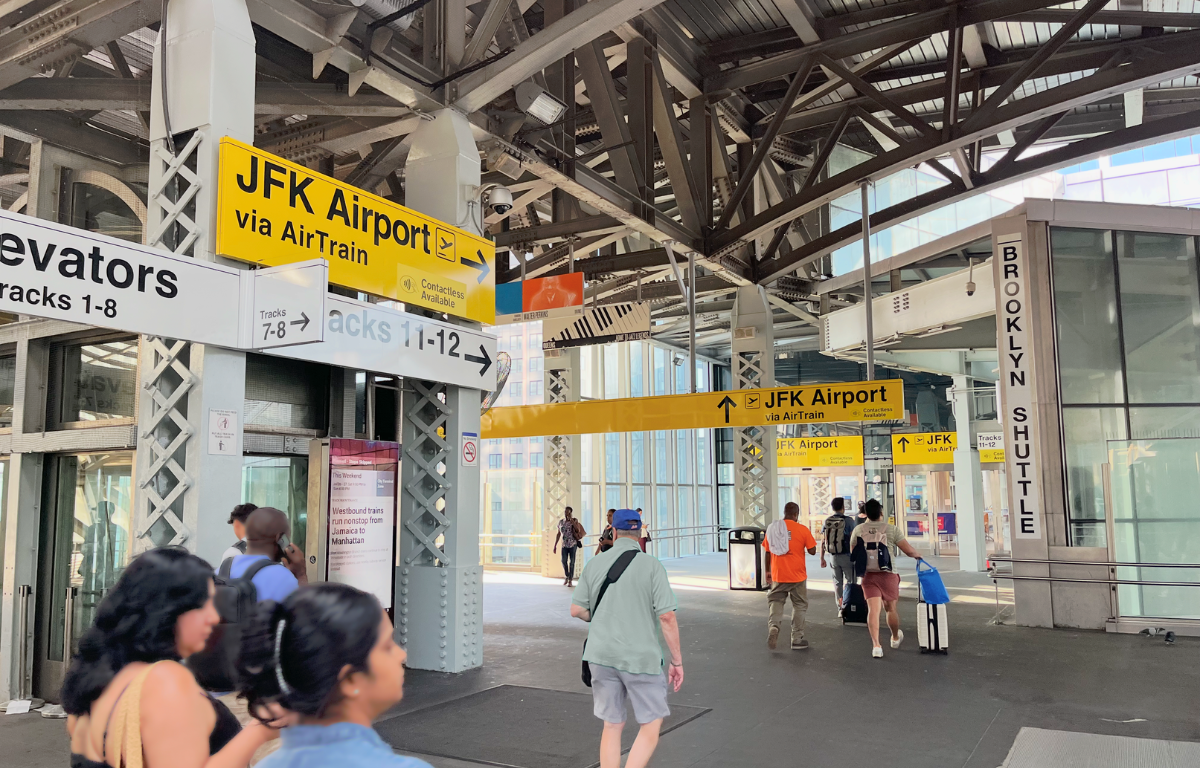
This is where consistent, visible, and strategic wayfinding becomes essential. Signage, architecture, environmental cues, and pedestrian flow work together to help travelers understand where they are, where they need to go, and what decision comes next. Effective wayfinding doesn’t eliminate the complexity of air travel; it helps make complexity easier to navigate.
Unique New York
New York’s three major airports each maintain their own identity, but they share a common ownership through the Port Authority of New York and New Jersey (PANYNJ). That shared oversight creates consistency across the region while allowing each airport to retain moments of distinction. A timed fountain at LGA or supersized NJ letters at EWR create a sense of place without compromising the larger navigational system.
The PANYNJ Airport Standards Manual for Pedestrian Signing & Wayfinding, designed by Mijksenaar, provides a systematic foundation for that experience. Since the implementation began in 2019, the standards have continued to shape wayfinding through ongoing renovations and construction across the region.
A recognizable color palette, universal symbols, consistent typography, and implementation frameworks give travelers something familiar to rely on, regardless of which airport they choose. For Via Collective, as we continue to extend the wayfinding system across the three airports, it is an opportunity to create greater clarity within an inherently complex journey.
Getting to “The City”
For many travelers, the most complicated part of arriving in New York doesn’t happen inside the airport at all. It happens in the transition between the airport and the city.
Although all airports offer taxis, rideshare services, and public transportation connections, differences in fares, transfers, and system navigation can quickly become difficult to understand—particularly for first-time visitors, those with low English proficiency, or with jet lag.
At JFK, AirTrain provides access to the Long Island Rail Road and Subway. From EWR, you can take a bus direct to Midtown or connect to Amtrak or New Jersey Transit via AirTrain. LGA offers the M60 and Q70 bus routes, that provide direct connections to the Subway, are the lowest fare of all options, and reduce the number of decisions travelers need to make.
Of course, ease of navigation is only part of the equation. Loading luggage onto a bus, subway, or train, and traveling for an hour or more can introduce its own challenges.
The lesson is simple: a journey doesn’t end when you leave the terminal. Every transition is part of the visitor experience.
Getting the Timing Right
If arriving in New York requires careful navigation, the journey back to the airport can feel even more high-stakes. Travel fatigue, time pressure, and the knowledge that a wrong turn could mean a missed flight all raise the stakes.
Over the past two decades, transportation improvements to airports have helped make these journeys more predictable. Consistent use of three-letter airport identifiers—JFK, EWR, and LGA—gives travelers reliable reference point and implementation of the wayfinding system provides comfort in the experience from one airport to another.
These details may seem small but consistency matters. When people are tired, distracted, or moving through an unfamiliar environment, familiar cues can reduce the number of decisions they need to make.
Traveling through New York’s airports will never be entirely stress-free. There are too many variables, too many people, and too many moving parts. But thoughtful design can make the journey feel more manageable.
At Via Collective, we see wayfinding as an opportunity to make complex journeys safer, more accessible, and easier to understand. From the first airport decision to the final connection home, every part of the journey matters, and we believe the experience should feel as clear and considered as possible.