
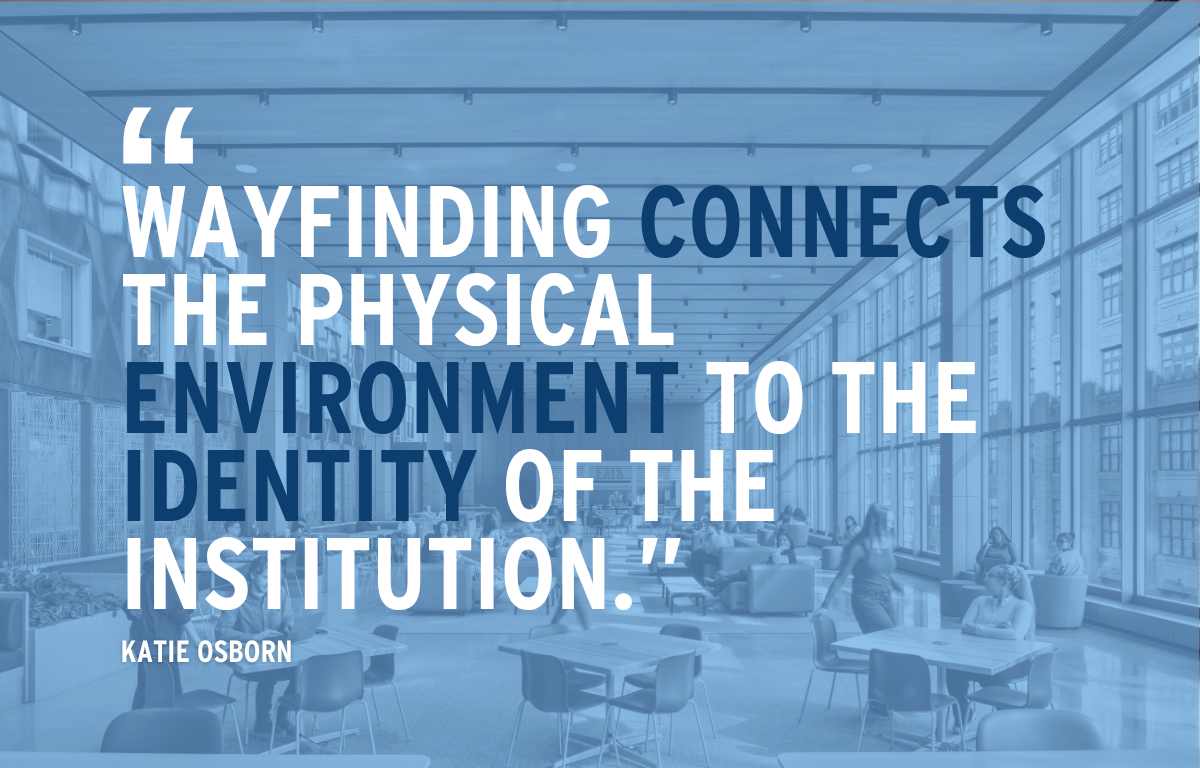
Recently, Via Collective’s Principal and Wayfinding Strategist, Katie Osborn, joined host Chris Morett on the EdUp Campus Planning podcast. Their conversation explored the intricate relationship between people and the spaces they navigate, peeling back the layers of what it truly means to design an intuitive environment. From a high-stakes hospital visit to a freshman’s first day on a sprawling university campus, the discussion illuminated a core philosophy Via Collective deeply holds: if we do our jobs well, nobody even knows we did them.
The interview provided a deep dive into the thinking that shapes the work, highlighting that wayfinding is far more than just placing signs on doors. It is a continuous, holistic journey that begins long before a visitor ever steps foot on the property.
Wayfinding as a Holistic Journey
One of the central themes of the episode was the idea that wayfinding begins with architecture and pre-arrival touchpoints. If a visitor cannot visually identify the front door of a building from the street, a sign directly above that door does little to help them navigate from afar.
What’s more, a visitor’s journey starts with the digital tools in their pocket. Pre-journey mapping, digital communications, and customer service all play a crucial role in preparing a visitor for their physical experience. When people are entering complex environments, such as a hospital or a bustling transit hub, they are often operating under a high “cognitive load.” Stress and anxiety limit a person’s ability to retain long lists of directional information. The role as wayfinders is to alleviate that stress by providing a seamless transition from the digital pre-journey to the physical space.
Designing for the 20%: The Campus Experience
When discussing university environments, a crucial metric highlighted for campus planners was the 80/20 rule. While wayfinding systems are built for everyone, they are heavily relied upon by the 20% of users who are brand new to the space.
For a freshman in their first two weeks of college, the stakes of navigation are incredibly high. The inability to find a calculus recitation or a mental health counseling center can lead to frustration, embarrassment, and a lack of belonging. By applying principles like progressive disclosure, giving people the right amount of information exactly when they need it, wayfinding can empower students. Good wayfinding fosters comfort, confidence, and ultimately, success.
The Value of a Wayfinding Master Plan
A key takeaway for university and campus planners is the critical need for a Wayfinding Master Plan. Often, wayfinding is treated as a secondary subset of an architectural project. However, while construction projects have strict physical boundaries, human visitors do not see these invisible lines. They expect continuous, connected guidance as they move from a newly renovated building into a legacy courtyard.
By utilizing a Wayfinding Master Plan, institutions can look beyond the boundaries of a single architectural update. It ensures that nomenclature, iconography, and navigational routes remain consistent across the entire campus, preserving the visitor’s mental map and ensuring a cohesive journey.
A Collective Effort
As in the podcast, Katie reflected on some of Via Collective’s most monumental projects, including recent work with the Obama Presidential Center and the ongoing revitalization of the AirTrain JFK. Through extensive stakeholder interviews, ranging from curators to facilities managers, wayfinders gain a 360-degree understanding of what successful navigation looks like for every user group.
This level of empathy and curiosity is driven by the heart of Via Collective: the team. And, it’s in the name: “Via” represents the way, and “Collective” represents the people. Whether collaborating with architects or relying on the diverse talents of Via Collective’s designers, Via Collective’s shared mission is clear: strive to craft environments where storytelling, clarity, and human connection take center stage, allowing the space itself to shine while the wayfinding works effortlessly in the background.
To hear the full conversation about the intersection of design, empathy, and spatial navigation, you can listen to Katie’s episode on the EdUp Campus Planning podcast.