
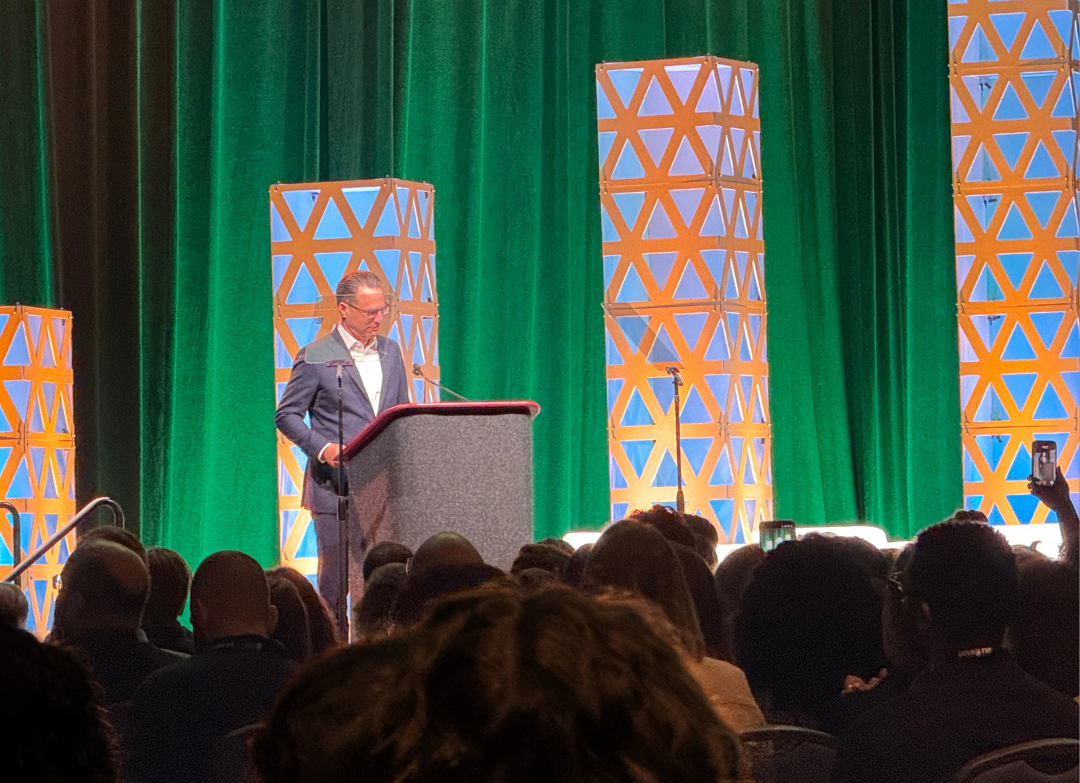
Pennsylvania Governor Josh Shapiro delivered welcoming and opening remarks at the American Alliance of Museums (AAM) Annual Meeting in Philadelphia, emphasizing museums as essential civic infrastructure. He positioned museums as vital community spaces that strengthen civic life, build stronger communities, and help preserve shared cultural heritage. He pledged ongoing state support for cultural organizations to ensure they have the resources to tell America’s full story. And most importantly, Shapiro pushed back against efforts to “erase and whitewash” difficult or painful chapters of history, arguing that societies must learn from their past to build a better future. This set a tone that surfaced repeatedly throughout the conference.
SCRUB NOTHING. Those were the words on a t-shirt that James E. Herr, Director of the Democracy Center at the Japanese American National Museum held up during the panel discussion ‘Memory as Resilience & Resistance: Museums, Democracy, and the Civic Space’
A presentation by Brandon Dillard, Director of Historic Interpretation and Audience Engagement at Monticello challenged attendees to trust audiences with complexity rather than simplifying difficult histories. He argued that people are capable of holding multiple truths at once and that museums should resist the urge to resolve historical tensions before presenting them. Using Monticello as an example, Dillard discussed the importance of acknowledging both Thomas Jefferson’s intellectual legacy and the lives of the enslaved people whose labor sustained the estate. Presenting those stories together, he suggested, is not contradictory—it is a more complete and honest understanding of history.
The conference highlighted the unique role museums occupy as one of the nation’s most trusted institutions. Research shared by AAM and Wilkening Consulting showed that trust in museums increased by 13 percent between 2021 and 2025, placing them among the most trusted institutions in the United States. Hearing those findings reinforced how much of that trust stems from the often-unseen work of curators, archivists, researchers, and educators who carefully preserve and interpret history.
Wayfinding throughout a museum continues to build that trust and deepen a person’s ability to connect with the present experience while exploring the past, and challenging the ideas of what the future can be. Museums help people understand their place in time, while wayfinding helps them understand their place in space.
A successful wayfinding system does more than guide people through a building. It influences what visitors encounter, in what sequence, and with what context. In museums and historic sites, those decisions become part of the interpretive experience. The path through a space can function as an argument, shaping understanding through movement and discovery. In that sense, wayfinding designers grapple with many of the same questions as curators and archivists: What gets emphasized? What gets discovered? What remains hidden?
There is, of course, a custodial version of the museum mission—protect the collection, maintain the building, and open the doors. What emerged in Philadelphia, however, was a more ambitious vision. Museums see themselves as stewards not only of objects but also of civic memory, public understanding, and democratic engagement.
Which brings the discussion back to that T-shirt.
It was humorous, but it also functioned as a mission statement. Scrub nothing from the record. Preserve the full story, even when it is complicated. The people who walk through museum doors deserve a complete picture of the past—and an opportunity to engage with all the complexities that come with it.